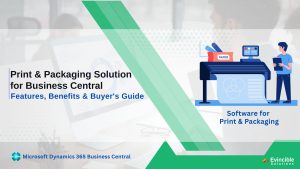
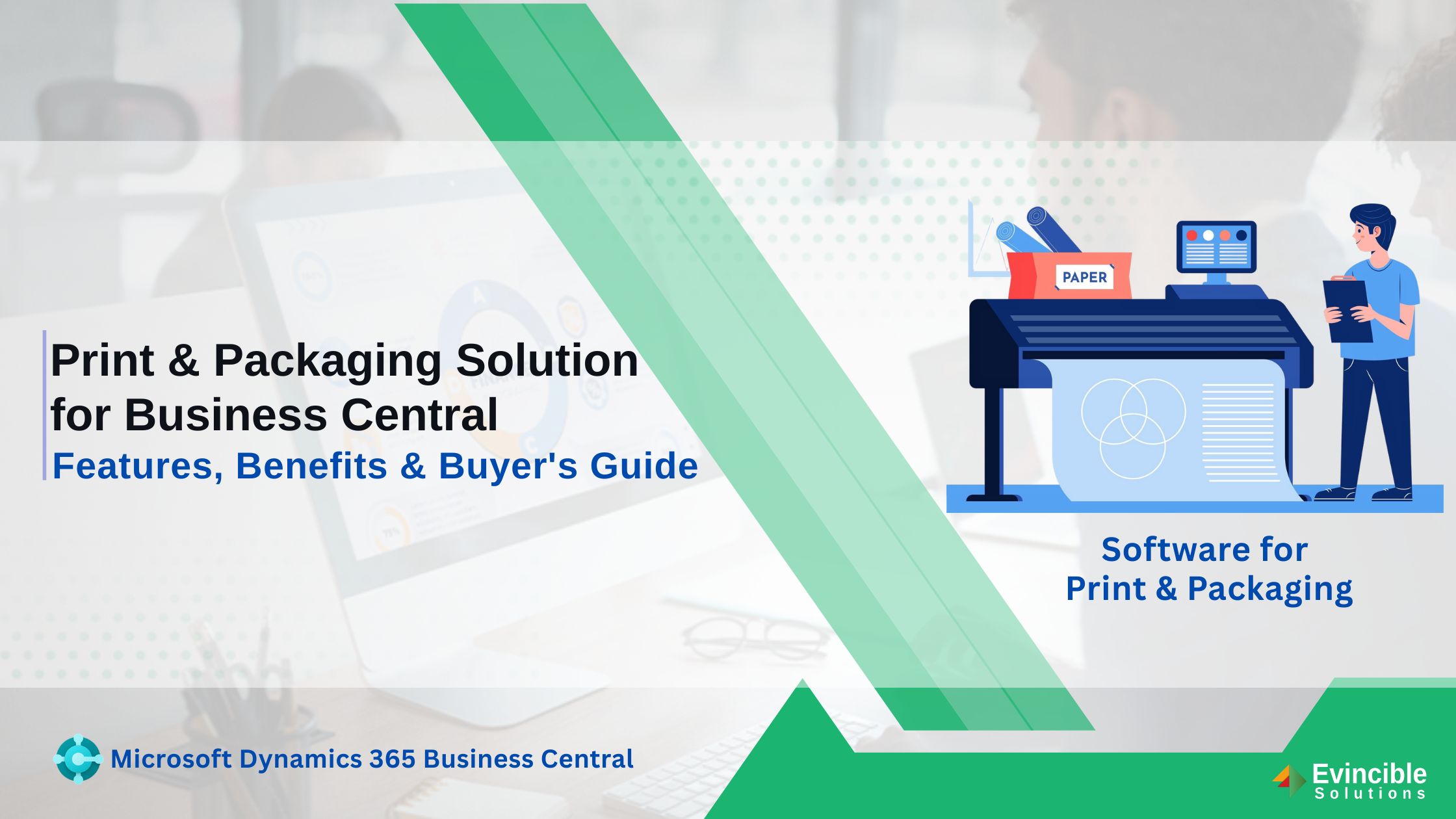
A Print & Packaging Solution for Business Central is built for one specific problem: print and packaging plants running estimating, scheduling, shop floor, and finance in disconnected systems or spreadsheets. By the time a job ships, the margin the estimator protected on paper has quietly eroded somewhere between the press and the invoice — and no one can pinpoint exactly where.
This solution adds print and packaging plant logic — estimating, job tickets, scheduling, shop floor execution, and costing — directly on top of Microsoft Dynamics 365 Business Central. The result is one connected system instead of a stack of point tools. It is not a generic ERP for packaging industry companies. It is a purpose-built layer on a platform packaging plants already know and trust. Evincible Solutions delivers this as an end-to-end implementation — from the first estimate to the shipped invoice.
This guide covers what the solution includes, why the packaging industry needs it, core capabilities, key benefits, segments served, and how implementation works — based on real plant-floor experience running jobs from estimate to press to shipment.
What Is a Print & Packaging Solution for Business Central — and Why ERP Matters for the Packaging Industry?
A Print & Packaging Solution for Business Central is an industry-specific layer built on top of standard Microsoft Dynamics 365 Business Central. It adds the plant reporting logic that print and packaging manufacturers need — logic that standard Business Central simply does not include out of the box.
Business Central remains the ERP foundation: financials, purchasing, inventory, and reporting all live there. The print and packaging layer sits on top and adds plant-specific logic without duplicating data across two separate systems or requiring a bolt-on integration that creates its own reconciliation headaches.
Packaging industry companies — from folding carton producers to label converters to corrugated manufacturers — face pressures that generic ERP software for the packaging industry was never designed to handle. Complex bills of materials, multi-location inventory, tight per-job margins, and rising traceability requirements all demand a system that understands how a packaging plant actually operates. Industrial packaging producers and consumer-facing manufacturers alike need to quote fast, protect margin per job, and prove lot-level traceability — often simultaneously.
Out-of-the-box Business Central has no press or die-cut logic, no job-ticket-level costing, and no make-ready or changeover visibility. That is the specific gap purpose-built ERP closes. Consider a plant that estimates a job accurately and wins the work at a healthy margin — only to find, at invoice time, that the margin is gone. No one knows whether it was lost on make-ready, material waste, or a changeover that ran long. That is exactly the problem a Print & Packaging Solution for Business Central solves.
Core Capabilities of a Print & Packaging Solution on Business Central
Packaging software solutions built on Business Central cover the full job lifecycle — from the first quote through to the final costing review. Here is what each capability delivers.
Estimating & Quoting
Build accurate folding carton, label, and corrugated quotes in minutes using pricing-rule templates. Estimators work from pre-configured rules that reflect the plant’s actual cost structure, so quotes are consistent, fast, and defensible — not rebuilt from scratch on every job.
Production Planning & Scheduling
Plan press, die-cut, and finishing work on a single schedule with clear visibility into make-ready time, run time, and changeovers. Planners can see what is queued, what is on press, and what is held up — all from one view instead of a whiteboard or a separate scheduling spreadsheet.
Shop Floor Execution
Capture time, materials, and waste at each operation so every job builds a complete record from quote to shipment. Shop floor data flows directly into costing, which means actual job performance is visible in real time — not reconstructed at month-end from paper records.
Inventory & Warehouse Management
Track board, inks, dies, plates, and finished goods with lot and location control directly inside Microsoft Dynamics 365. Packaging management software that keeps inventory in a separate system creates reconciliation work every time a job closes. Keeping materials and finished goods in the same system as financials and production eliminates that entirely.
Quality & Compliance
Record inspections, approvals, and nonconformance with full lot traceability for every component and finished item. For plants supplying regulated industries or large retail customers, this traceability is a requirement that needs to be built into the daily workflow — not handled as a separate exercise at audit time.
Finance & Costing
See planned versus actual margin by job, customer, product line, and plant — using data that lives in the same system as the general ledger. There is no reconciled export, no manual bridge between production and accounting. The number the finance team sees is the same number the plant manager sees, and it reflects what actually happened on the floor. That shared visibility is what turns packaging data software solutions from a reporting exercise into a management tool — margin by job, by machine, and by customer, updated as work progresses rather than at month-end.
Advantages of Adopting a Software Package Solution for Print & Packaging Plants
The advantages of adopting a software package solution extend well beyond replacing spreadsheets. Here is what mid-market plants consistently gain:
- Single source of truth: production, inventory, and financials in one system — no more reconciling three separate data sources to understand where a job stands.
- Faster, more accurate quoting that protects margin from estimate to invoice. When the quote is built on real plant costs, the margin is defensible at every stage of the job.
- Reduced manual reconciliation between the shop floor and accounting. When data flows automatically, finance teams stop spending time chasing job actuals.
- Better decision-making with real margin, waste, and capacity data by machine and by customer. Management can see which jobs, customers, and product lines are actually profitable — and act on that information.
- Built on Microsoft’s roadmap — software packaging solutions on Business Central evolve with the platform. Plants get continuous improvements without repeated re-implementations.
- Right-sized for mid-market plants: enough depth to replace disconnected point tools without the cost and timeline of a large-scale, multi-year ERP programme.
Who Needs a Print & Packaging Solution for Business Central?
Packaging for manufacturers varies significantly by substrate, process, and customer requirement. This solution is tailored for the three primary mid-market print and packaging segments. It also supports packaging services industries that sit adjacent to those three — trade finishers, contract converters, and specialist display producers — with the same estimating and costing logic.
Folding Carton
Multi-up layouts, board grade management, and die libraries for high-volume carton work — supporting consumer-packaged goods brands and manufacturers. Plants running high volumes of carton jobs need speed, consistency, and the ability to manage complex die and board combinations without manual workarounds.
Labels & Flexibles
Roll-based costing, slit and rewind, and ink usage visibility for narrow and wide web producers. Label converters work in a different cost structure than carton plants — roll yields, ink coverage, and rewind specifications all affect margin. The solution reflects that structure rather than forcing label jobs into a generic manufacturing template.
Corrugated & Display
Sheet and box level visibility, design iterations, and project-based work for POP displays and industrial packaging. Corrugated and display work often involves multiple design rounds, custom structural specifications, and project-based delivery timelines. The solution supports that workflow from first specification through to final shipment.
How Implementation Works: A Practical Path to Adoption
Whether a plant is running a legacy on-premise ERP or a mix of point tools, implementation follows a structured, practical sequence that respects current operations and plant capacity.
Step 1 — Assessment
Walk through the current quoting, scheduling, production, and shipping flow to map exactly where handoffs break down. The goal is to understand the real workflow — not the ideal one — so the system is shaped around how the plant actually operates rather than how it theoretically should.
Step 2 — Fit Workshop
Match real jobs from the plant to the Print & Packaging Solution on Dynamics 365 Business Central. This is where the solution design gets validated against actual job types, press configurations, and costing requirements — before any configuration work begins.
Step 3 — Roadmap
Lay out a practical sequence for rollout that respects peak seasons and current plant commitments. Plants do not stop running during implementation. The roadmap is built around that reality, with a sequence that protects ongoing operations while moving the project forward.
Why Teams Choose Evincible Solutions
A Print & Packaging Solution for Business Central closes the gap between generic ERP and the real operational needs of print and packaging plants. Estimating, production, inventory, quality, and finance all work from the same data — so decisions are made inside the system, not inside spreadsheets.
- Decision confidence, not workarounds — consistent data across production, inventory, and finance means management can trust the numbers they see.
- Designed for long-term adoption — built for operators, planners, and finance teams, helping the system remain relevant and trusted well beyond go-live.
- Aligned with Microsoft’s roadmap — built directly on Dynamics 365 Business Central, so the solution evolves with Microsoft’s platform without forcing frequent re-implementations.
- Ongoing involvement as operations change — as plants add locations, complexity, or new requirements, the partnership continues to support refinement and continuous improvement.
Ready to see how it works for your plant? Book a plant-focused demo and start with a short conversation about your current landscape and what you would like to see.