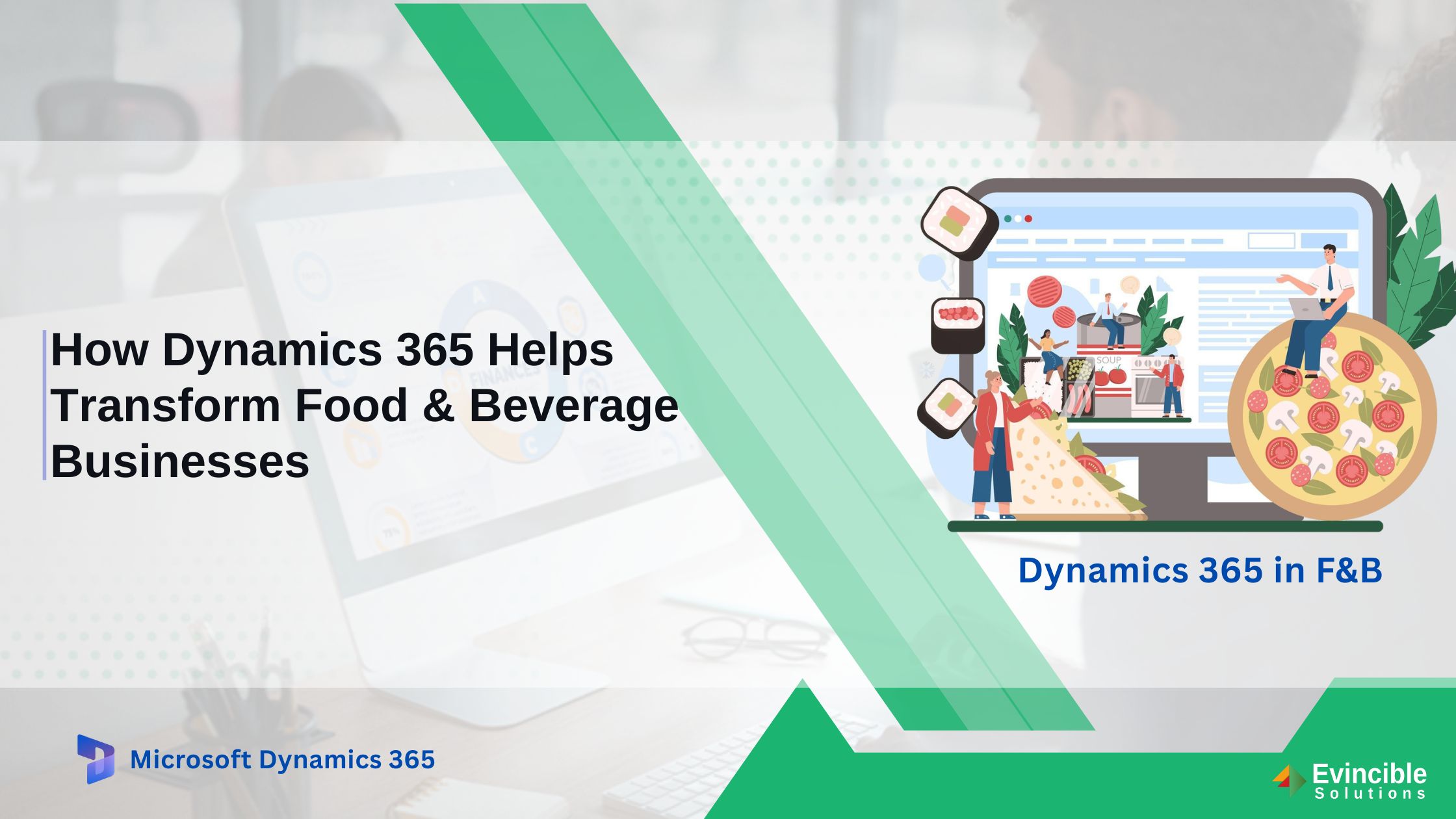
Running a food and beverage business means managing perishable inventory, volatile ingredient costs, strict regulatory requirements, and a supply chain that can shift without warning. One disruption — a delayed shipment, a failed audit, or a product recall — can have consequences that ripple across the entire operation.
That is why more F&B businesses are turning to Dynamics 365 for food and beverage industry — a unified ERP and CRM platform built to address these challenges head-on. This article covers the key industry challenges, the core capabilities of Dynamics 365 as food and beverage ERP software, a breakdown of which product fits your business size, and what to look for in an implementation partner.
Challenges Facing the Food & Beverage Industry Today
Food and beverage businesses operate under a unique set of pressures that generic ERP systems are rarely built to handle. From the farm gate to the retail shelf, food and beverage industry challenges compound at every stage of the supply chain.
Supply Chain Complexity & Rising Input Costs
Ingredient prices fluctuate with commodity markets, weather events, and geopolitical shifts. Managing a multi-tier supplier network — where each node carries its own lead times, quality standards, and compliance requirements — adds layers of complexity that manual processes simply cannot absorb.
Without real-time visibility across the supply chain, procurement teams are left reacting to shortages rather than planning around them. Effective supply chain management for food and beverage businesses requires systems that can model supplier risk, automate replenishment, and track cost variances in real time.
Food Safety & Regulatory Compliance Pressure
HACCP protocols, allergen labeling mandates, and traceability requirements are not optional — they are baseline expectations from regulators, retailers, and consumers alike. A single mislabeled allergen or a gap in batch documentation can trigger a product recall that costs far more than the product itself.
Food safety and compliance management has become a continuous operational discipline, not a periodic audit exercise. Businesses need systems that capture compliance data at the point of production, not retroactively.
Perishability, Waste & Inventory Accuracy
Shelf-life constraints make inventory accuracy a financial issue, not just an operational one. Overstocking leads to spoilage; understocking leads to lost sales. Neither outcome is acceptable in a margin-thin industry.
First Expired, First Out (FEFO) picking discipline, real-time lot tracking, and accurate demand signals are essential for inventory management for food and beverage operations. Without them, waste accumulates quietly and erodes profitability over time.
What Is Dynamics 365 for Food and Beverage Industry?
Microsoft Dynamics 365 is a unified cloud platform that combines ERP and CRM capabilities into a single, integrated system. For food and beverage businesses, it is available across two product tracks: Dynamics 365 Business Central, designed for small and mid-sized producers and distributors, and Dynamics 365 Finance & Operations paired with Supply Chain Management, built for large-scale manufacturers with complex process manufacturing requirements.
Both tracks share the same Microsoft cloud infrastructure — meaning they integrate natively with Microsoft 365, Power BI, Power Automate, and Microsoft Copilot. You can review the official Microsoft Dynamics 365 Business Central overview for product-level detail on the SMB track. The result is a connected operational platform where finance, production, warehousing, sales, and compliance data all live in one place rather than scattered across disconnected systems.
Key Features of Microsoft Dynamics 365 for Food & Beverage Businesses
The following capabilities represent where Microsoft Dynamics 365 Food and Beverage ERP delivers the most direct operational value for F&B organizations.
Food Safety & Compliance Management
Dynamics 365 captures ingredient traceability at every stage of production — from raw material receipt through processing, packaging, and distribution. Each batch is documented with full lot genealogy, meaning recall readiness is built into normal operations rather than assembled under pressure.
Allergen tracking is managed at the ingredient and formula level, reducing the risk of cross-contamination and mislabeling. Temperature control parameters and HACCP checkpoints can be embedded directly into production workflows, creating a continuous compliance record that supports both internal audits and external regulatory inspections. Traceability and recall management shift from a reactive process to a proactive one.
Manufacturing & Production Management
For F&B manufacturers, production planning requires more than a standard bill of materials. Dynamics 365 supports formula and recipe management, allowing production teams to define ingredient ratios, yield expectations, and substitution rules at the formula level.
Catch weight and batch management is handled natively — critical for businesses dealing with products priced and tracked by variable weight, such as meat, seafood, or bulk produce. Demand forecasting and capacity planning tools help production schedulers align output with anticipated orders, reducing both overproduction and stockouts.
Supply Chain & Warehouse Management
Dynamics 365 provides real-time visibility across the full supply chain — from purchase orders and supplier lead times through inbound logistics, storage, and outbound fulfillment. Paired with Supply Chain Management solutions, it extends that visibility into multi-tier supplier networks and demand-driven replenishment.
Supplier collaboration tools allow vendors to confirm orders, update delivery schedules, and share quality documentation within the system.
In the warehouse, FEFO picking rules are enforced automatically, ensuring that products closest to expiry are picked first. The integrated Warehouse Management System (WMS) supports barcode scanning, directed put-away, and real-time inventory counts — giving warehouse managers accurate stock visibility without manual reconciliation. Distribution optimization tools help route outbound orders efficiently, particularly for businesses managing direct store delivery or multi-depot distribution networks.
For F&B distributors managing field sales and van routes, Dynamics 365 also integrates with purpose-built Van Sales & DSD solutions for direct store delivery operations — keeping field sales data connected to central inventory and order management in real time.
Customer, Sales & Marketing Management
On the commercial side, Dynamics 365 CRM capabilities support personalized customer engagement across distributor and retail channels. Sales teams can track order history, pricing agreements, and promotional activity at the account level, enabling more accurate forecasting and targeted outreach.
Order fulfillment workflows are automated from quote through delivery, reducing manual handoffs between sales, operations, and logistics. For food and beverage ERP software to deliver real commercial value, the sales and operations functions need to share the same data — and that is exactly what Dynamics 365 enables. For a closer look at how this plays out in food service specifically, see our guide to Restaurant ERP software.
AI-Powered Analytics & Copilot Insights
Power BI dashboards embedded within Dynamics 365 give operations, finance, and supply chain teams real-time reporting without manual data exports. Managers can monitor KPIs — fill rates, spoilage rates, production yields, cost variances — in dashboards that update as transactions occur. Microsoft Copilot for Dynamics 365 takes this further by surfacing AI-driven insights directly within workflows. Copilot can flag demand anomalies, summarize supplier performance trends, and generate draft responses to customer inquiries — reducing the analytical burden on operations teams. AI in food and beverage ERP is no longer a future consideration; it is a live capability within the current platform.
Dynamics 365 Business Central vs. Supply Chain Management — Which Fits Your F&B Business?
The right product depends on the scale and complexity of your operations.
Dynamics 365 Business Central is the right fit for small and mid-sized food and beverage producers and distributors. It covers financials, inventory, production, and basic supply chain management in a single, manageable system. For food and beverage businesses evaluating Dynamics 365 Business Central, the appeal is clear: full ERP functionality without the overhead of an enterprise platform.
For large-scale manufacturers — those managing multi-plant production, complex process manufacturing, or cross-border distribution — Dynamics 365 Finance & Operations paired with Supply Chain Management provides the depth and scalability required. Advanced lot control, catch weight handling, multi-entity financials, and global compliance capabilities are all available at this tier.
Both platforms are built on the same Microsoft cloud infrastructure, meaning businesses that start on Business Central can scale up to F&O as operations grow — without starting over.
Benefits of Implementing Dynamics 365 in Your Food & Beverage Business
The operational impact of Dynamics 365 spans every function of a food and beverage business. Key benefits of Dynamics 365 for food and beverage include:
- Reduced spoilage and waste through real-time inventory visibility and automated FEFO picking
- Faster, audit-ready compliance and recall response — with full batch traceability captured during normal operations
- Improved margins through accurate costing, demand forecasting, and reduced overproduction
- Stronger customer retention through personalized engagement, accurate order fulfillment, and consistent service levels
- Scalable platform that grows with multi-site operations — from a single production facility to a global distribution network
- Unified data across finance, operations, sales, and supply chain — eliminating the reporting delays that come from disconnected systems
- AI-powered insights that reduce manual analysis and surface operational risks before they become costly problems
These outcomes are not theoretical — explore Evincible Solutions’ Dynamics 365 case studies to see how F&B and distribution businesses have realized them in practice.
How to Choose the Right Dynamics 365 Implementation Partner
Selecting a Dynamics 365 partner for food and beverage industry deployments is as important as selecting the software itself. The right partner brings more than technical knowledge — they bring F&B-specific process expertise, familiarity with compliance requirements, and experience configuring industry-specific capabilities like catch weight, allergen tracking, and FEFO.
Look for a partner with a demonstrable track record in food and beverage implementations, the ability to provide ISV add-ons and extensions where out-of-box functionality falls short, and a support model that covers post-go-live stabilization — not just the initial deployment. Evincible Solutions’ F&B track record spans over two decades of Microsoft Dynamics expertise and a global implementation footprint across manufacturing, distribution, and F&B operations. Their Dynamics 365 consultancy team makes them a strong starting point for businesses evaluating their implementation options.
Ready to Modernize Your Food & Beverage Operations with Dynamics 365?
Microsoft Dynamics 365 gives food and beverage businesses the tools to manage compliance, control costs, reduce waste, and build supply chains that can absorb disruption without breaking. Whether the priority is tightening lot traceability, automating FEFO in the warehouse, or connecting sales data with production planning, the platform delivers measurable operational improvement across the business. Explore the full Dynamics 365 for food and beverage capabilities, book a free consultation with Evincible Solutions, or contact us directly to discuss how Dynamics 365 can be configured for your specific F&B operation.