Running a restaurant today means juggling tighter margins, rising food costs, and operations that span the kitchen, the front counter, and every delivery app you’re plugged into.
For many restaurant businesses, the real bottleneck is not the food or the service — it is the technology holding everything together.
Disconnected systems create disconnected operations. A standalone POS with no restaurant POS integration to inventory. A manual, spreadsheet-based procurement process that can’t keep up with demand. Accounting that delivers last month’s numbers when managers need today’s. Each gap costs money, time, and accuracy.
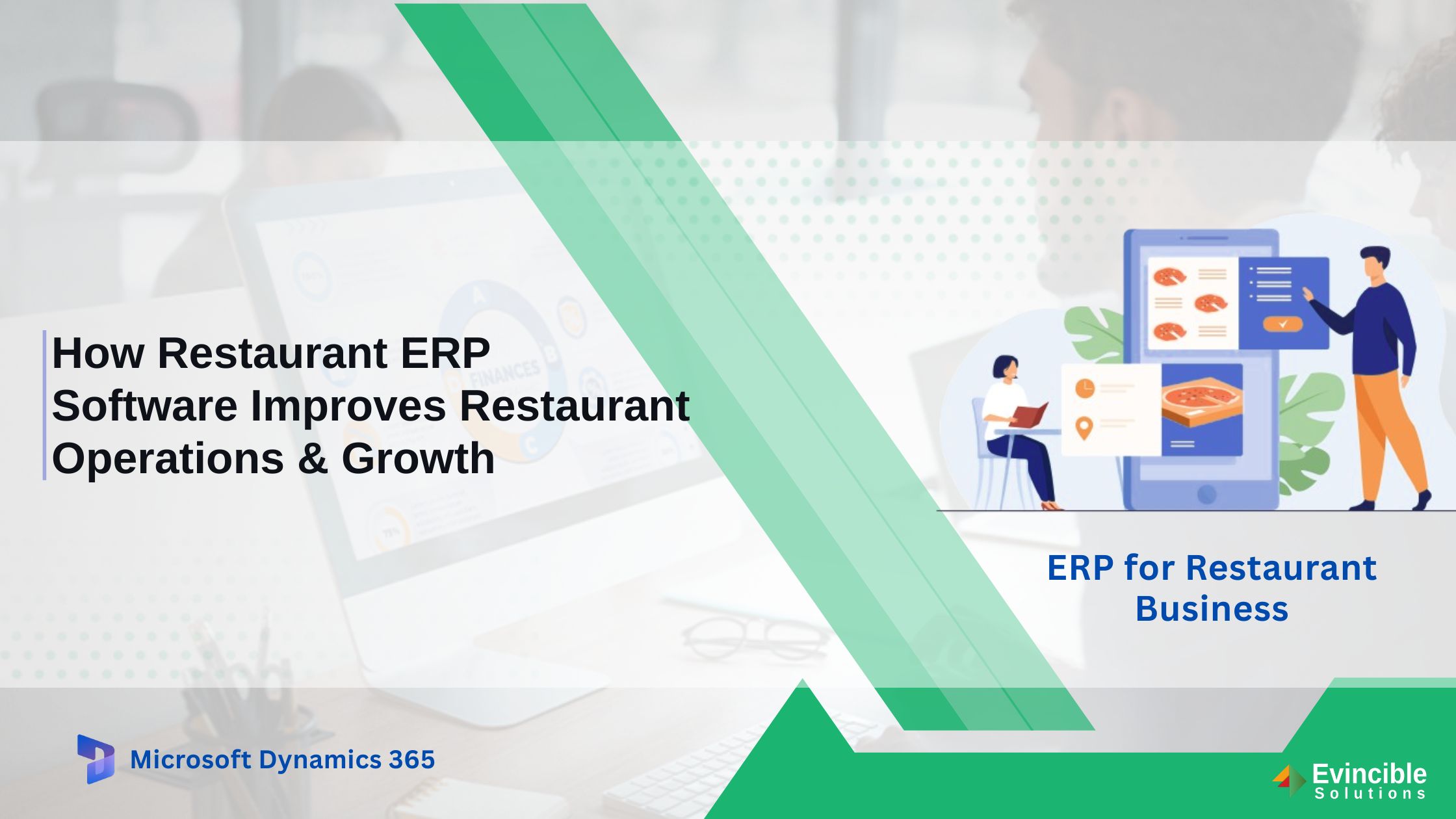
This is where Restaurant ERP Software — built on Microsoft Dynamics 365 Business Central — changes the equation. By connecting every core function, such as inventory, procurement, finance, customer management, and multi-location reporting, into a single cloud-based platform, restaurant businesses gain the visibility and control needed to operate profitably at any scale.
Operational Challenges of Traditional Restaurant Management Systems
Most restaurants begin with a collection of standalone tools that feel manageable at one or two locations. As the business grows, the cracks in that approach become impossible to ignore.
Disconnected POS, Inventory, and Finance Systems
When the point of sale, inventory platform, and accounting software operate independently, data consistency is a constant struggle. Every reconciliation cycle requires someone to manually pull figures from multiple sources, cross-check them, and correct the errors that accumulate between systems.
Duplicate data entry across departments wastes staff time and increases the chance of mismatched records between systems. Delayed financial reporting means management decisions are made on last week’s numbers rather than today’s reality. As more locations are added, the administrative burden scales faster than the business does — turning growth into an operational strain.
Inventory Visibility Challenges in High-Volume Restaurants
Industry research shows inaccurate stock tracking is one of the leading causes of food waste in restaurant kitchens before it ever reaches a customer. Without real-time inventory visibility, procurement decisions rely on estimates rather than data, leading to overstocking items that expire and running short on high-demand ingredients at exactly the wrong moment.
Manual purchase orders, untracked vendor pricing, and no automated reorder alerts keep kitchens operating reactively. The problem compounds across multi-location operations, where purchasing decisions are made without a consolidated view of group-wide stock levels.
Multi-Location Restaurant Management Complexity
Managing a single outlet is one challenge. Managing five, fifteen, or fifty is fundamentally different. Without a centralized system, branch-level reporting becomes inconsistent — each location may follow its own processes, apply different pricing structures, and manage inventory independently, creating a fragmented picture for group executives.
Menu standardization is difficult to enforce without a unified platform. Compliance with group-level policies, pricing controls, and operational standards varies from branch to branch, undermining both brand consistency and margin control.
Managing Multiple Delivery Platforms
The growth of delivery aggregators — Uber Eats, DoorDash, Talabat, Foodpanda, and Deliveroo — has created a significant new operational layer. Orders arrive from multiple platforms simultaneously, each with its own interface, reporting format, and revenue reconciliation requirement.
Without integration, staff manually enter orders into the POS or kitchen display system — a process with a risk of mistyped items, missed orders, and delayed kitchen updates. Inventory deductions do not happen in real time, leading to persistent mismatches between available stock and active menu items. Reconciling revenue across five or more platforms is a time-consuming monthly exercise that few finance teams can manage accurately without dedicated tooling.
Why Restaurants Are Moving Toward Cloud ERP Solutions
More restaurant businesses are moving away from on-premise software because it simply can’t keep pace with how modern operations run across locations, delivery platforms, and shifting demand.
Anywhere access means owners and managers can monitor operations, review dashboards, and approve purchase orders from any device, regardless of location. Automatic updates ensure the system is always current without IT intervention or scheduled downtime windows that disrupt operations.
Real-time visibility across inventory, sales, financials, and procurement means a manager can catch a stock shortage or a margin dip the same day it happens — not weeks later in a reconciliation report.
Cloud ERP also eliminates the cost of on-site servers and reduces the IT overhead associated with maintaining on-premise infrastructure. Scalability becomes a software configuration rather than a capital investment — adding a new location requires provisioning access, not purchasing new hardware. Security is built in, with data encrypted in transit and at rest, backed up automatically, and protected by compliance standards that most independent restaurant businesses couldn’t maintain on their own.
How Microsoft Dynamics 365 Supports Digital Transformation in the Restaurant Industry
Microsoft Dynamics 365 is a cloud-based suite of intelligent business applications that combines ERP and CRM capabilities within a single unified platform. Built for organizations that need enterprise-level functionality without enterprise-level complexity, it connects finance, operations, supply chain, customer engagement, and analytics in one environment.
For restaurant businesses, Microsoft Dynamics 365 for Restaurants and Cafés addresses the operational challenges while delivering capabilities tailored to the speed, volume, financial accuracy, and compliance demands of food service operations.
Automating Manual Restaurant Workflows
One of the most immediate benefits of implementing Dynamics 365 is the elimination of manual, paper-based workflows that slow operations and create errors. Purchase approvals move through configured authorization workflows, reducing unauthorized spending and accelerating procurement cycles.
Vendor management is centralized — supplier records, pricing agreements, and performance histories maintained in a single system. Invoice processing is automated through three-way matching between purchase orders, goods receipts, and supplier invoices, significantly reducing accounts payable workload. Inventory replenishment triggers are set based on par levels, automatically generating purchase requests when stock falls below defined thresholds.
Kitchen requests and employee workflows — shift scheduling, task assignment, and labor reporting — are managed within the same platform, eliminating the need for disconnected tools. Microsoft Power Automate extends these capabilities further, enabling custom workflow automation across systems without requiring development resources.
Improving Operational Agility Through Cloud Technology
In Dynamics 365 specifically, branch synchronization ensures every location operates from the same data environment in real time. Managers access live dashboards from mobile devices on the floor, in the kitchen, or across the city — providing real-time visibility into sales performance, inventory levels, and staff activity.
Branch synchronization ensures all locations operate from the same data environment. A price update, a menu change, or a new purchasing policy applied at group level flows through to every branch simultaneously. Decisions that once required compiling reports from multiple sources can now be made in real time, with confidence in the accuracy of the underlying data.
Enabling Data-Driven Restaurant Management
Restaurant businesses generate significant data every day — sales transactions, ingredient usage, delivery volumes, customer orders, and cost variances. The challenge is converting that data into actionable insight quickly enough to act on it.
Dynamics 365, integrated with Microsoft Power BI, delivers executive dashboards that surface sales trends, food cost analysis, profitability by location or menu category, and customer behavior patterns. KPI monitoring is built into the platform — operators set targets and receive alerts when performance deviates from plan. Customer insights from CRM data can directly inform menu development, promotional strategy, and loyalty program design, connecting operational performance to commercial growth.
Supporting Long-Term Restaurant Growth Strategies
New branch onboarding is fast in Dynamics 365 because operational templates — chart of accounts, approval workflows, inventory categories, and reporting structures — are standardized and replicable across every new location. Standard operating procedures are embedded in system workflows, ensuring consistency from the first day of trading at every new location. The platform’s architecture also supports integration with emerging technologies, from AI-assisted demand forecasting to automated kitchen management systems, ensuring the businesses remain relevant as the industry evolves.
Evincible Solutions, a Microsoft Solutions Partner with multiple successful implementations across North America, Canada, KSA, provides the Microsoft Dynamics 365 Consulting Services tailored to restaurant businesses in the Middle East and globally.
Why Multi-Location Restaurants Need Centralized ERP Systems
For restaurant groups operating across multiple locations, decentralized management is not a strategy — it is a risk. A centralized ERP system resolves the structural inefficiencies that fragment operations and obscure the true financial picture of the business.
Standardizing Operations Across Restaurant Branches
A centralized Restaurant ERP Software establishes unified workflows that every branch follows without exception. Menu consistency is enforced through centralized recipe management, ensuring every location prepares dishes to the same specification and cost structure. Centralized purchasing controls prevent unauthorized procurement and consolidate buying power, enabling better vendor negotiation and more effective cost management across the group.
Pricing consistency across locations is maintained through the system, eliminating the risk of individual branch managers applying ad hoc discounts or regional price variations that erode margin control.
Centralized Data Visibility for Restaurant Owners
Group-level reporting gives restaurant owners and executives a consolidated view of performance across the entire operation. Branch comparison reports surface which locations are outperforming on revenue, cost of goods sold, labor costs, and profitability and which require management attention — allowing resources to be directed accurately rather than reactively without waiting for end-of-month reports.
Profitability insights at the menu item, location, and time-of-day level enable continuous optimization of the menu mix, staffing model, and operating hours, turning data into a genuine competitive advantage.
Supporting Restaurant Expansion and Franchise Growth
The cloud infrastructure underpinning Dynamics 365 is designed to scale without friction. Standard operating procedures, configured in the system, are applied automatically to new branches — maintaining consistency from day one. For franchise models, central governance tools including approval workflows, spending limits, and reporting requirements ensure compliance across the network without constant manual oversight from head office.
Key Features Every Restaurant ERP Software Should Include
Not all ERP platforms are built for the specific demands of food service operations. When evaluating restaurant management software, these capabilities are non-negotiable.
Integrated POS and Financial Management
The foundation of effective restaurant ERP is a direct connection between the point of sale and the financial management system. Every transaction at the POS should flow automatically into the general ledger, eliminating manual reconciliation and ensuring financial reports reflect real-time trading activity. VAT calculation, split payment handling, and multi-currency support are essential for restaurants operating across different markets.
Inventory and Procurement Automation
Real-time inventory tracking at the ingredient level — not just the finished dish — gives kitchen teams the visibility to manage food costs with precision. Industry benchmarks suggest restaurants using integrated inventory management systems can see a 2–5% reduction in food cost percentage, meaningful savings without any change to the menu or pricing. Automated procurement workflows triggered by pre-set par levels ensure stock is replenished before shortages occur, removing the reactive purchasing cycle that drives up costs.
Recipe Costing and Food Waste Tracking
Recipe costing functionality calculates the theoretical cost of every dish based on current ingredient prices, enabling operators to monitor actual versus theoretical food costs in real time. Variance analysis identifies exactly where waste is occurring — whether through over-portioning, spoilage, or process gaps — enabling targeted corrective action before costs escalate.
Given how easily food waste erodes margin — through over-portioning, spoilage, and prep loss — waste tracking is not a nice-to-have; it’s a direct margin protection tool. Systematic waste monitoring, supported by ERP data, enables restaurant operators to identify patterns, adjust procurement, and improve portion discipline across every location.
Multi-Branch Reporting and Analytics
Restaurant ERP Software must provide consolidated reporting across all locations, not just individual branch views. Performance dashboards should allow executives to compare locations by revenue, cost percentage, customer count, and profitability — and drill into the underlying data when anomalies appear.
Scheduled reports delivered automatically — daily sales summaries to branch managers, weekly P&L snapshots to executives — remove the need for anyone to chase down numbers manually.
Customer Relationship and Loyalty Management
CRM integration allows restaurant businesses to track customer preferences, purchase history, and visit frequency — building the data foundation for effective loyalty programs and targeted marketing. Customer feedback management, integrated with operational data, identifies service gaps before they become reputational issues. For delivery-focused operations, customer lifetime value analysis helps prioritize retention investment and identify the highest-value segments.
Mobile Access and Cloud Security
Restaurant management does not happen behind a desk. Mobile access to dashboards, approval workflows, and operational data is essential for managers working across a busy service environment. Cloud security — including role-based access controls, encrypted data storage, and automated backups — protects sensitive business and customer data, an increasingly important requirement as data protection regulations tighten across GCC markets.
Business Benefits of Restaurant ERP Software
Implementing the right Restaurant ERP Solution delivers impact across the business:
- Lower food costs and less waste through real-time inventory tracking and portion control
- Reduced operational costs through automated purchasing, invoice matching, and approvals
- Improved customer satisfaction through order accuracy and consistency across every channel
- Simplified regulatory compliance, including ZATCA e-invoicing requirements in Saudi Arabia
- Faster, more consistent expansion into new locations or franchise markets
- Fewer manual errors and less time spent reconciling numbers across systems
Why Choose Microsoft Dynamics 365 Business Central for Restaurants
Among the available cloud ERP platforms, Dynamics 365 Business Central for Restaurants stands out for its combination of capability, flexibility, and deep integration with the broader Microsoft ecosystem.
Business Central connects natively with Power BI for analytics, Microsoft 365 and Teams for communication and collaboration, and Microsoft Copilot for AI-powered insights and task automation. Restaurant operators are not choosing a standalone tool — they are investing in a connected business intelligence environment that grows in capability with every Microsoft update.
AI capabilities within Business Central and Copilot enable predictive inventory management, automated document processing, and intelligent demand forecasting — giving growing restaurant groups planning tools that used to require a dedicated data team to build. The scalable licensing model allows businesses to start with core modules and activate additional functionality as requirements evolve, protecting the initial investment as the business grows.
Security runs on Microsoft Azure infrastructure, with data residency options in the UAE and Saudi Arabia and the same certifications that global enterprises rely on. Customization capabilities allow Evincible Solutions to tailor Business Central to the specific workflows, reporting requirements, and integrations that individual restaurant businesses need — without compromising the stability of the core platform.
Restaurant ERP in Saudi Arabia: Supporting Vision 2030
Saudi Arabia’s food service sector is one of the fastest-growing in the region. The market was valued at approximately USD 29 billion in 2024 and is projected to grow at a CAGR of around 8-9% through 2030, driven by Vision 2030’s focus on tourism development, a growing urban population, and expanding franchise activity across Riyadh, Jeddah, and emerging cities.
Vision 2030 has set an explicit target of reducing national food waste by 50% by 2030 — a direct mandate for restaurant operators to invest in systems that provide the visibility, tracking, and reporting necessary to meet that goal. Currently, food waste costs the Kingdom approximately SAR 40 billion annually, making operational efficiency both a commercial and a national priority.
Microsoft Dynamics 365 supports Saudi restaurant operators in meeting specific regulatory and operational requirements that generic ERP platforms cannot address. ZATCA e-invoicing compliance is fully supported, enabling restaurants to meet Saudi tax authority requirements without manual workarounds. Food safety compliance tracking aligned with SFDA requirements is managed within the system. Multi-lingual operations in both Arabic and English ensure that the platform works effectively across all staff levels and management tiers.
For restaurant groups expanding across the Kingdom under Vision 2030’s growing hospitality infrastructure — from destination projects to new hotel developments — Dynamics 365 provides the centralized governance and scalable architecture needed to grow confidently without outgrowing the platform.
Modernize Your Restaurant Operations with Microsoft Dynamics 365
Restaurant businesses that continue to rely on disconnected systems carry an operational cost that compounds over time — in delayed decisions and missed opportunities. Microsoft Dynamics 365 brings together inventory control, financial visibility, procurement automation, customer relationship management, and multi-location reporting in a single, cloud-based environment.
Evincible Solutions brings specialized expertise in Microsoft Dynamics 365 Implementation for restaurant businesses across the Middle East and globally. As a Microsoft Solutions Partner with offices in KSA, UAE, USA, Canada, and Pakistan, the team works alongside restaurant groups to deliver implementations configured for the specific demands of food service operations.
For ongoing system performance, dedicated Microsoft Dynamics 365 Support Services ensure the platform continues to operate at the level the business requires, with expert assistance.
Ready to bring your restaurant operations together under one intelligent system? Book a Consultation with Evincible Solutions and find out how Microsoft Dynamics 365 can be configured for your specific restaurant business.